A Real-World Analysis of the Population with Hepatitis C Virus Infection Affected by Type 2 Diabetes in Italy: Patients’ Characteristics, Comorbidity Profiles and Treatment Patterns
Background and Objectives: HCV infection represents a main risk factor for type 2 diabetes (T2D). This real-world analysis investigated the HCV-positive (HCV+) population with a T2D co-diagnosis in Italy. Methods: From 2017 to 2021, HCV+ patients were identified from administrative databases and stratified into T2D-HCV+ and HCV+-only cohorts in the presence/absence of a T2D diagnosis. Both cohorts were further divided by treatment with direct-acting antivirals (DAAs). The subgroups were compared for demographic variables, comorbidity profiles, most frequent hospitalizations, and drug prescriptions before inclusion. A sensitivity analysis was performed on patients included after 2019, the year of widespread use of pangenotypic DAAs. Results: Considering HCV+ patients aged ≥55 years, T2D-HCV+ patients (N = 1277) were significantly (p < 0.001) older than HCV+-only (N = 6576) ones and burdened by a worse comorbidity profile (average Charlson index: 1.4 vs. 0.3, p < 0.05). Moreover, regardless of T2D presence, DAA-treated patients were older (p < 0.001) and had a worse Charlson index than the untreated ones. T2D-HCV+ patients showed tendentially higher hospitalization rates and co-medication prescriptions compared to the HCV+-only patients. After 2019, a trend towards reduced co-medication use in DAA-treated patients was noticed, especially antibiotics and cardiovascular drugs. Conclusions: The co-presence of T2D in HCV+ patients resulted in a worse clinical status, as confirmed by the more frequent requirement of hospitalizations and complex polypharmacy regimens
A real-world analysis of outcomes and healthcare costs of patients on perindopril/indapamide/amlodipine single-pill vs. multiple-pill combination in Italy
This analysis compared adherence, cardiovascular (CV) events and all-cause mortality incidence, and healthcare costs among hypertensive patients treated with perindopril (PER)/indapamide (IND)/amlodipine (AML) in single-pill combination (SPC) vs. multiple-pill combination, in a real-world setting in Italy. In this observational retrospective analysis of Italian administrative databases, adult patients treated with PER/IND/AML between 2010 and 2020 were… Read More »A real-world analysis of outcomes and healthcare costs of patients on perindopril/indapamide/amlodipine single-pill vs. multiple-pill combination in Italy
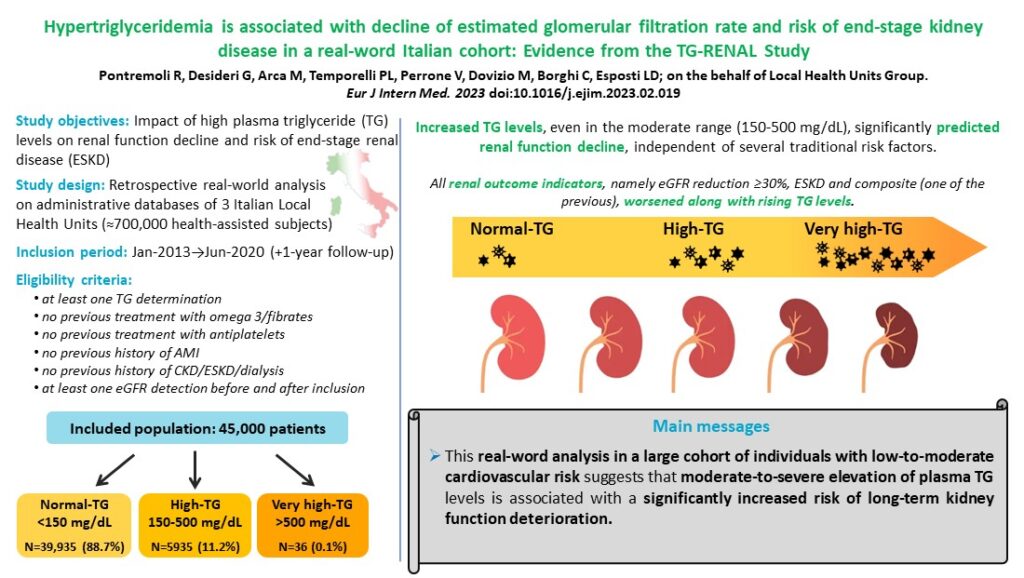
Hypertriglyceridemia is associated with decline of estimated Glomerular filtration rate and risk of end-stage kidney disease in a real-word Italian cohort: Evidence from the TG-RENAL Study
Background: This analysis investigated the role of hypertriglyceridemia on renal function decline and developmentof end-stage kidney disease (ESKD) in a real-world clinical setting.Methods: A retrospective analysis using administrative databases of 3 Italian Local Health Units was performedsearching patients with at least one plasma triglyceride (TG) measurement between 2013 and June 2020,followed-up until June 2021. Outcome… Read More »Hypertriglyceridemia is associated with decline of estimated Glomerular filtration rate and risk of end-stage kidney disease in a real-word Italian cohort: Evidence from the TG-RENAL Study