Journal of Clinical Medicine

Treatment Switching and Drug Survival of Biologic Therapies in Psoriasis: A Real-World Italian Study Across Biologic Classes

Background/Objectives: Psoriasis is a chronic inflammatory skin disease leading to substantial
psycho-physical and social burden and reduced quality of life. Biologic agents
have transformed its therapeutic landscape. This real-world Italian study described the
pattern of treatment with biologic drugs in patients with psoriasis. Methods: A retrospective
observational study was conducted using administrative databases from Italian
Local Health Units, covering nearly 12 million individuals. The study included adults
with psoriasis identified from January 2015 to March 2025 by hospitalization, co-payment
exemption code, or topical anti-psoriatic prescriptions. Patients initiating a biologic drug
(anti-TNFα, anti-IL12/23, anti-IL17, and anti-IL23) were selected and further analyzed
in terms of treatment switching, drug survival, and healthcare resource utilization and
related costs within the first year after biologic initiation, and compared. Results: A total
of 10,270 biologic-naïve adult patients was included in the analysis (anti-TNFα N = 5078;
anti-IL12/23 N = 767; anti-IL17 N = 2574; anti-IL23 N = 1851). Most patients (95.0%) starting
an anti-IL23 agent did not switch. Compared with anti-TNFα, initiating an anti-IL23
inhibitor was associated with a significant reduced risk of switching (HR = 0.186; 95%CI:
0.144–0.240; p < 0.001). According to the cost analysis stratified by switching status, remaining on the index biologic was associated with a lower economic burden. Although differences between switchers vs. non-switchers among anti-IL23 users did not reach statistical significance (€12,052 vs. €11,406, respectively, p = 0.132), data support the economic advantage associated with greater treatment stability. Conclusions: Anti-IL23 agents showed effective, durable first-line use with potential long-term clinical and economic benefits in moderate-to-severe psoriasis.

Real-World Evidence on Disease Burden and Economic Impact of Paroxysmal Nocturnal Haemoglobinuria in Italy

Background/Objectives: This analysis was conducted in Italy to estimate the epidemiology of paroxysmal nocturnal hemoglobinuria (PNH) and to describe the features and economic burden of PHN in the adult population considering the role of anti-complement therapy with C5/3-inhibitors (C5/3i). Methods: Administrative databases of healthcare entities covering approximately 12 million citizens were used to estimate the prevalence and incidence of PNH. Demographics, clinical characteristics and healthcare costs were analyzed among adults with PHN stratified by the presence/absence of C5/3i therapy. Results: The prevalence in Dec-2021 of PNH in adults was 17.6/1,000,000 people, and the incidence rate in the period 2011–2022 was 1.5/1,000,000/year. In 142 patients with at least 12 months of data available before and after inclusion (mean age: 50.7 years; 45.8% males), 27% received C5/3i therapy. The main baseline comorbidities were aplastic anemia and other bone marrow failure syndromes, found in 10.6% of patients and more common in C5/3i-treated than untreated patients (18.4% vs. 7.7%). Cost analysis showed that the average cost per patient per year (PPPY) was EUR 41,084, mainly driven by drug expenses (87% of total costs), especially anti-complement therapy (80%). RBC transfusions were the most impactive item among the hospitalization costs (EUR 1982 of EUR 4284 PPPY). The C5/3i-treated cohort was associated with higher total costs (EUR 133,472 vs. EUR 8089, p < 0.001), mainly due to drug expenses (EUR 127,180 vs. EUR 3217, p < 0.001). Conclusions: This real-world analysis confirmed a rising PNH prevalence in Italy, aligning with global data. Despite available therapies, many patients face a high disease burden, suggesting potential benefits from novel treatments targeting upstream complement components.

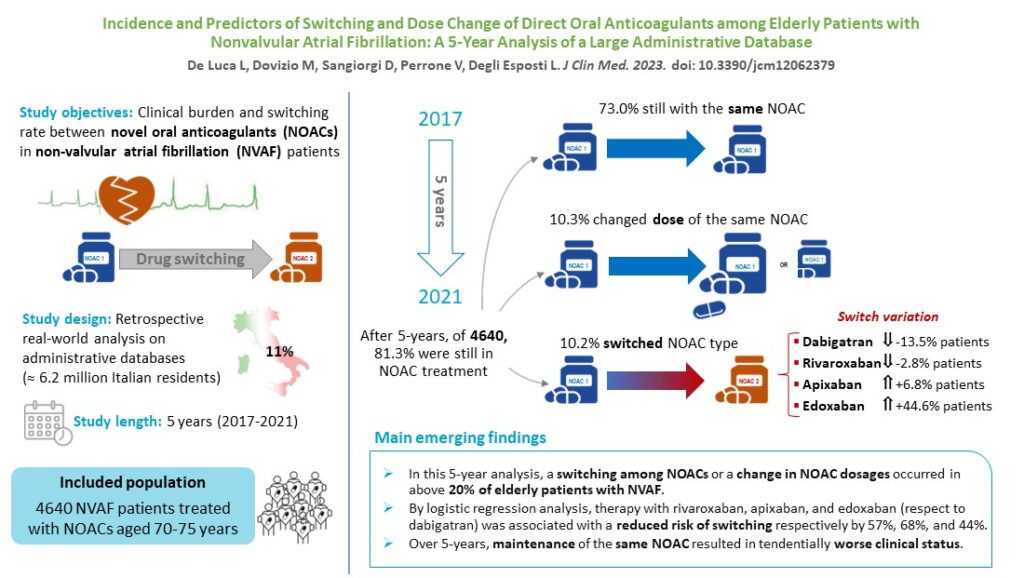
Incidence and Predictors of Switching and Dose Change of Direct Oral Anticoagulants among Elderly Patients with Nonvalvular Atrial Fibrillation: A 5-Year Analysis of a Large Administrative Database

In the last decade, novel oral anticoagulants (NOACs) have emerged as prominent therapeutic options in non-valvular atrial fibrillation (NVAF). We analysed the clinical burden and the switching rate between all available NOACs, and their dosage change over a period of 5 years in a representative population of patients with NVAF aged between 70 and 75… Read More »Incidence and Predictors of Switching and Dose Change of Direct Oral Anticoagulants among Elderly Patients with Nonvalvular Atrial Fibrillation: A 5-Year Analysis of a Large Administrative Database

person holding pencil near laptop computer

Real-World Evidence on Disease Burden and Economic Impact of Sickle Cell Disease in Italy

A real-world analysis was conducted in Italy among sickle cell disease (SCD) patients to evaluate the epidemiology of SCD, describe patients’ characteristics and the therapeutic and economic burden. A retrospective analysis of administrative databases of various Italian entities was carried out. All patients with ≥1 hospitalization with SCD diagnosis were included from 01/2010-12/2017 (up to… Read More »Real-World Evidence on Disease Burden and Economic Impact of Sickle Cell Disease in Italy