Real-World Progression-Free Survival and Healthcare Resource Utilization Associated with Daratumumab Use in Transplant-Ineligible Multiple Myeloma Patients in Italy
Purpose: This study evaluated real-world clinical and economic outcomes associated with daratumumab-based regimens in patients with multiple myeloma (MM) ineligible for autologous stem cell transplantation (ASCT) in Italy. Differences in healthcare resource use according to daratumumab administration route (intravenous vs subcutaneous) were also explored.
Methods: A retrospective observational analysis was conducted using administrative healthcare databases from Italian Local Health Units covering ~12 million individuals (2018– 2023). Patients with MM receiving daratumumab in first-line (1L) or second-line (2L) therapy were included. Real-world progression-free survival (rwPFS), defined as time to treatment switch or death, was used as a proxy endpoint for disease progression, and healthcare resource utilization were compared between treatment regimens. Propensity score weighting was applied to to improve comparability between treatment groups. Direct healthcare costs captured in administrative databases were analyzed from the perspective of the Italian National Health System.
Results: Among 790 non-ASCT MM patients, 344 received 1L DaraRd and 413 received 2L DaraRd. In the 1L setting, median rwPFS was not reached for DaraRd and was 25.7 months for Rd (p=0.011). In 2L, median rwPFS was 42.9 months for DaraRd versus 19.1 months for Rd (p < 0.001). In 1L, DaraRd was associated with lower hospitalization costs compared with Rd for both all-cause (€ 4324 vs € 7971) and MM-related (€ 2862 vs € 6693) admissions. In 2L, differences in hospitalization costs were smaller and not statistically significant.
Conclusion: In this real-world analysis, daratumumab-based regimens were associated with longer rwPFS compared with Rd among transplant-ineligible MM patients, in both 1L and 2 L settings. In 1L treatment, these outcomes were accompanied by lower hospitalization costs. Given the retrospective design and the use of administrative healthcare data, these findings should be interpreted with caution, but they contribute to the growing body of real-world evidence on treatment outcomes and resource utilization in routine clinical practice.
Characteristics, therapeutic pathway and the economicburden of patients with drug-resistantepilepsy: A real-world analysis following the introduction of cenobamate inItaly
Abstract Objectives: Drug-resistant epilepsy (DRE) remains a major clinical challenge, affecting approximately one-thirdof patients with epilepsy. Cenobamate, a novel antiseizure medication (ASM) approved in Italy in 2022, has shown promisein clinical trials. However, real-world data on its use, especially economic evaluations, remain limited. This analysis assessed the impact of cenobamate in Italian clinical practice, focusing… Read More »Characteristics, therapeutic pathway and the economicburden of patients with drug-resistantepilepsy: A real-world analysis following the introduction of cenobamate inItaly
Evaluation of biochemical and economic outcomes in patients treated with PCSK9 inhibitors in a real clinical practice setting
BACKGRO UND : PCSK9 inhibitors (PCSK9i) in combination with high-dose statins can reduce LDL -cholesterol (LDL-C) levels by 50-60% over statin monotherapy. This analysis investigated biochemical (LDL-C reduction) and economic outcomes in Italian patients treated with PCSK9i or potentially eligible but untreated.METHOD S: Administrative databases of healthcare institutions covering around 5 million residents were used… Read More »Evaluation of biochemical and economic outcomes in patients treated with PCSK9 inhibitors in a real clinical practice setting
A Real-World Analysis of the Population with Hepatitis C Virus Infection Affected by Type 2 Diabetes in Italy: Patients’ Characteristics, Comorbidity Profiles and Treatment Patterns
Background and Objectives: HCV infection represents a main risk factor for type 2 diabetes (T2D). This real-world analysis investigated the HCV-positive (HCV+) population with a T2D co-diagnosis in Italy. Methods: From 2017 to 2021, HCV+ patients were identified from administrative databases and stratified into T2D-HCV+ and HCV+-only cohorts in the presence/absence of a T2D diagnosis. Both cohorts were further divided by treatment with direct-acting antivirals (DAAs). The subgroups were compared for demographic variables, comorbidity profiles, most frequent hospitalizations, and drug prescriptions before inclusion. A sensitivity analysis was performed on patients included after 2019, the year of widespread use of pangenotypic DAAs. Results: Considering HCV+ patients aged ≥55 years, T2D-HCV+ patients (N = 1277) were significantly (p < 0.001) older than HCV+-only (N = 6576) ones and burdened by a worse comorbidity profile (average Charlson index: 1.4 vs. 0.3, p < 0.05). Moreover, regardless of T2D presence, DAA-treated patients were older (p < 0.001) and had a worse Charlson index than the untreated ones. T2D-HCV+ patients showed tendentially higher hospitalization rates and co-medication prescriptions compared to the HCV+-only patients. After 2019, a trend towards reduced co-medication use in DAA-treated patients was noticed, especially antibiotics and cardiovascular drugs. Conclusions: The co-presence of T2D in HCV+ patients resulted in a worse clinical status, as confirmed by the more frequent requirement of hospitalizations and complex polypharmacy regimens
Profile, Healthcare Resource Consumption and Related Costs in ANCA-Associated Vasculitis Patients: a Real-World Analysis in Italy
Anti-neutrophil cytoplasmic antibody (ANCA)-associated vasculitides (AAV) are rare autoimmune diseases triggeringinflammation of small vessels. This real-world analysis was focused on the most common AAV forms, granulomatosis with polyangiitis (GPA) and microscopic polyangiitis (MPA), to describe patients’ demographic and clinical characteristics,therapeutic management, disease progression, and the related economic burden. A retrospective analysis was conducted on administrative… Read More »Profile, Healthcare Resource Consumption and Related Costs in ANCA-Associated Vasculitis Patients: a Real-World Analysis in Italy
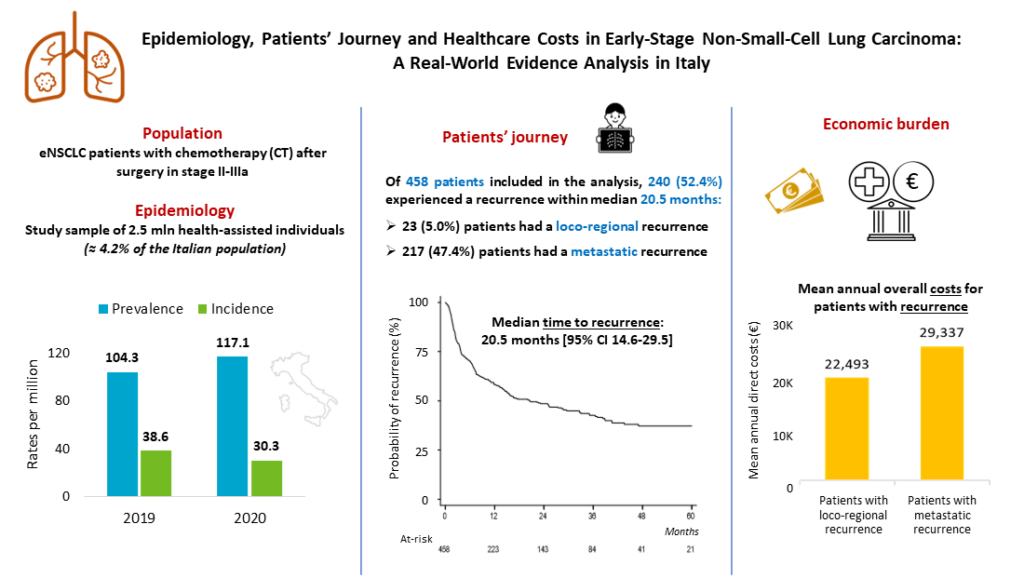
Epidemiology, Patients’ Journey and Healthcare Costs in Early-Stage Non-Small-Cell Lung Carcinoma: A Real-World Evidence Analysis in Italy

This real-world analysis aims to estimate the epidemiology and economic burden related to early-stage non-small-cell lung carcinoma (eNSCLC) in the clinical practice Italian setting. An observational analysis was performed using administrative databases linked to pathological anatomy data, covering around 2.5 mln health-assisted individuals. From 2015 to mid-2021, eNSCLC patients staged II–IIIA treated with chemotherapy after… Read More »Epidemiology, Patients’ Journey and Healthcare Costs in Early-Stage Non-Small-Cell Lung Carcinoma: A Real-World Evidence Analysis in Italy
Healthcare Resource Consumption and Related Costs in Patients on Antiretroviral Therapies: Findings from Real-World Data in Italy
This real-world analysis conducted on administrative databases of a sample of Italian healthcare entities was aimed at describing the role of therapeutic pathways and drug utilization in terms of adherence, persistence, and therapy discontinuation in HIV-infected patients under antiretroviral therapies (ART) and Tenofovir Alafenamide (TAF)-based regimens on healthcare resource consumption and related direct healthcare costs. Between 2015 and 2019, adults (≥18 years) prescribed with TAF-based therapies were identified and characterized in the year prior to the first prescription (index-date) for TAF-based therapies and followed-up until the end of data availability. Overall, 2658 ART-treated patients were included, 1198 of which were under a TAF-based regimen. TAF-based therapies were associated with elevated percentages of adherence (83.3% patients with proportion of days covered, PDC > 95% and 90.6% with PDC > 85%) and persistence (78.5%). The discontinuation rate was low in TAF-treated patients, ranging from 3.3% in TAF-switchers to 5% in naïve. Persistent patients had lower overall mean annual healthcare expenditures (EUR 11,106 in persistent vs. EUR 12,380 in non-persistent, p = 0.005), and this trend was statistically significant also for costs related to HIV hospitalizations. These findings suggest that a better therapeutic management of HIV infection might result in positive clinical and economic outcomes.

Italian real-world analysis of the impact of polypharmacy and aging on the risk of multiple drug-drug interactions (DDIs) in HCV patients treated with pangenotypic direct-acting antivirals (pDAA)
Purpose: The study aims at investigating the impact of polymedication and aging in the prevalence of multiple drug-drug interactions (DDIs) on HCV patients treated with sofosbuvir/velpatasvir (SOF/VEL) or glecaprevir/pibrentasvir (GLE/PIB). Patients and Methods: This is a retrospective analysis based on administrative data covering around 6.9 million individuals. Patients treated with SOF/VEL or GLE/PIB over November… Read More »Italian real-world analysis of the impact of polypharmacy and aging on the risk of multiple drug-drug interactions (DDIs) in HCV patients treated with pangenotypic direct-acting antivirals (pDAA)
The Influence of Iron-Deficiency Anaemia (IDA) Therapy on Clinical Outcomes and Healthcare Resource Consumptions in Chronic Kidney Disease Patients Affected by IDA: A Real-Word Evidence Study among the Italian Population
Anaemia is a uraemia-related complication frequently found in non-dialysis-dependent chronic kidney disease (ND-CKD) patients, with iron-deficiency anaemia (IDA) as the main underlying mechanism. Given the suboptimal anaemia management in ND-CKD patients with a co-diagnosis of IDA, this study evaluated the role of IDA therapy on clinical outcomes and healthcare resource consumptions in an Italian clinical… Read More »The Influence of Iron-Deficiency Anaemia (IDA) Therapy on Clinical Outcomes and Healthcare Resource Consumptions in Chronic Kidney Disease Patients Affected by IDA: A Real-Word Evidence Study among the Italian Population
Analysis of Patients with Focal Epilepsy and Drug-Resistant Epilepsy in Italy: Evaluation of Their Characteristics, Therapeutic Pathway and the Consumption of Healthcare Resources
Purpose: A retrospective analysis was conducted to estimate the number of patients with focal epilepsy and drug-resistant epilepsy (DRE) and their characteristics, the therapeutic patterns, the consumption of health resources in a real-world Italian setting.Patients and Methods: A retrospective study was carried out on the administrative databases of a sample of Italian Health Departments, covering… Read More »Analysis of Patients with Focal Epilepsy and Drug-Resistant Epilepsy in Italy: Evaluation of Their Characteristics, Therapeutic Pathway and the Consumption of Healthcare Resources